

%20(Custom).png)

English from Scratch for Kids: A Step-by-Step Roadmap for Absolute Beginners

May 22, 2026
.
5 minutes

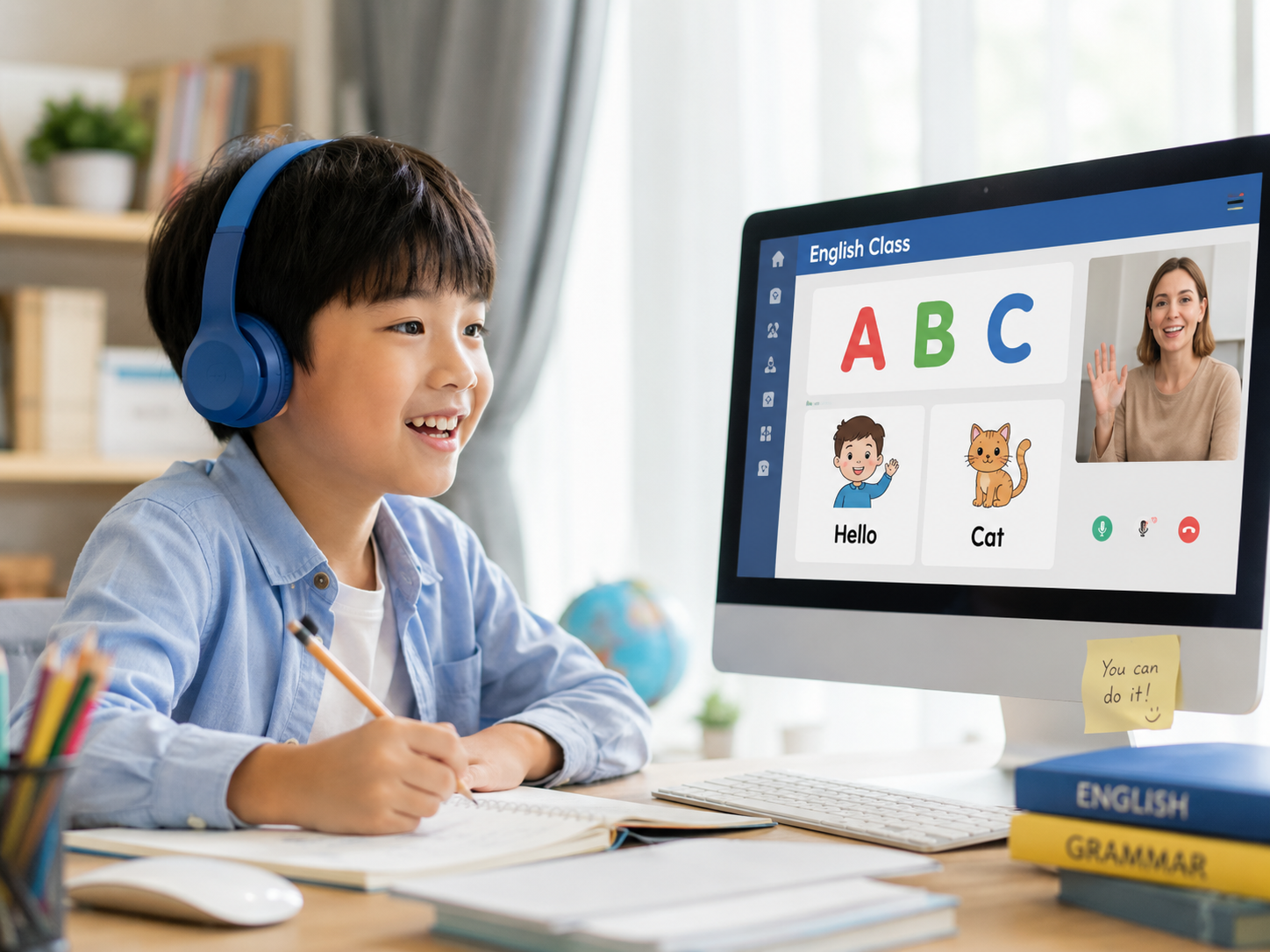
English from Scratch for Kids: A Step-by-Step Roadmap for Absolute Beginners
Starting English can feel like a big challenge for a child who does not know a single word yet. Parents may wonder whether they should begin with the alphabet, vocabulary, grammar, reading, or speaking.
The good news is that learning English from scratch does not have to be difficult or stressful. Children learn most effectively when English is introduced gradually through meaningful words, repetition, games, stories, and real communication.
This roadmap explains how to help an absolute beginner move from their first English words to simple, confident conversations.
What Does “Learning English from Scratch” Mean?
Learning English from scratch means that a child begins with little or no previous knowledge of the language.
An absolute beginner may not yet be able to:
- Understand basic English instructions
- Introduce themselves
- Recognize common English words
- Read English letters and sounds
- Build simple sentences
- Answer basic questions
This is completely normal. Every confident English speaker once started with their first word.
The goal at the beginning is not to teach complicated grammar rules or memorize long vocabulary lists. The first goal is to help the child understand that English is a tool they can use to communicate.
Step 1: Build a Positive First Experience
A child’s first experience with English can shape their attitude toward the language for years.
Lessons should feel friendly, playful, and achievable. Children need to feel that making mistakes is a normal part of learning—not something embarrassing.
At this stage, parents and teachers should:
- Praise effort instead of perfection
- Use pictures, gestures, toys, and facial expressions
- Introduce only a few new words at a time
- Repeat familiar activities
- Avoid correcting every small mistake
- Give the child enough time to respond
A child who feels relaxed is more likely to participate, repeat new words, and try speaking independently.
Step 2: Start With Useful Everyday Vocabulary
Absolute beginners need words they can immediately connect to objects, people, and actions in their daily lives.
Good first topics include:
- Colors
- Numbers
- Animals
- Toys
- Food
- Family members
- Body parts
- Clothes
- Feelings
- Classroom objects
- Everyday actions
For example, a child can begin with words such as:
red, blue, cat, dog, apple, water, mom, dad, happy, sad, run, eat, sleep
It is better to learn five useful words and practice them several times than to introduce twenty words that the child quickly forgets.
How to practise new vocabulary
New words should appear in different activities. A child might first see a picture of a dog, hear the word “dog,” repeat it, find a toy dog, and then use the word in a short sentence.
This creates a stronger connection between the word and its meaning.
Parents can also use simple questions:
- What is this?
- Is it a cat or a dog?
- What color is it?
- Where is the ball?
- Do you like apples?
The child may initially answer with one word. That is still real progress.
Step 3: Teach Simple Phrases, Not Only Individual Words
Vocabulary is important, but children also need to understand how words work together.
Once a child recognizes a few basic words, introduce short phrases they can use in real situations:
- My name is Anna.
- I am six.
- I like cats.
- This is my mom.
- I want water.
- It is blue.
- I am happy.
- I can jump.
- I do not know.
- Can you help me?
Learning complete phrases helps children communicate earlier and prevents them from seeing English as a disconnected list of words.
At the beginning, phrases should be short, repetitive, and connected to the child’s life.
Step 4: Develop Listening Skills
Before children speak comfortably, they need many opportunities to hear understandable English.
However, simply playing English videos in the background is not enough. Beginners benefit most from language that is:
- Slow and clear
- Supported by pictures or actions
- Repeated several times
- Connected to a familiar topic
- Appropriate for their age and level
A teacher might say, “Touch your nose,” while demonstrating the action. The child can understand and respond without needing a translation.
Other useful beginner instructions include:
- Stand up.
- Sit down.
- Look here.
- Show me the cat.
- Point to the apple.
- Open the book.
- Choose a color.
- Listen and repeat.
These small interactions gradually train the child to process English naturally.
Step 5: Encourage Speaking From the Beginning
Parents sometimes believe children should spend months learning vocabulary and grammar before they start speaking. In reality, beginner learners can use spoken English from their first lessons.
Speaking does not need to begin with long conversations.
A child may start by:
- Repeating a word
- Choosing between two answers
- Completing a phrase
- Answering with one word
- Saying a complete sentence
- Asking a simple question
- Taking part in a short conversation
For example:
Teacher: What color is the ball?
Child: Red.
Teacher: Yes! It is a red ball.
Child: It is a red ball.
This type of supportive repetition helps the child move naturally from understanding to independent speaking.
Step 6: Introduce Phonics and English Sounds
English spelling can be confusing because the same letter may appear in different words and sounds. A structured introduction to phonics helps children connect written letters with spoken language.
Beginners can start by learning:
- Common letter sounds
- The first sound in familiar words
- Simple sound combinations
- Short consonant-vowel-consonant words
- Basic rhyming patterns
Examples include:
- c as in cat
- d as in dog
- s as in sun
- at in cat, hat, and bat
- og in dog, log, and frog
Phonics should be combined with pictures, speaking, and vocabulary. It should not become a long exercise in memorizing isolated sounds.
Young learners usually respond better when phonics is taught through games, movement, stories, and familiar characters.
Step 7: Move Into Simple Reading
Once children recognize common words and understand basic phonics, they can begin reading very short texts.
Suitable beginner reading materials include:
- Picture labels
- Flashcards
- Simple captions
- Repetitive sentences
- Short dialogues
- Beginner stories
- Mini-books with illustrations
An early reading activity may contain sentences such as:
This is a cat.
The cat is black.
The cat can run.
The text should contain mostly familiar words so that the child can focus on reading rather than constantly trying to understand new vocabulary.
Parents should not worry if progress seems slow. Reading in a new language requires children to combine several skills at once: recognizing letters, remembering sounds, understanding words, and following the meaning of a sentence.
Step 8: Add Writing Gradually
Writing should begin only after the child has heard, spoken, and recognized the target language.
For absolute beginners, writing can start with:
- Tracing letters
- Matching words to pictures
- Copying familiar words
- Completing missing letters
- Rearranging words into sentences
- Writing short answers
- Describing a picture with one sentence
Later, the child may write simple sentences such as:
- My name is Leo.
- I am seven years old.
- I have a dog.
- My favorite color is green.
Writing tasks should remain short and manageable. A beginner should not be expected to write long paragraphs before developing enough vocabulary and sentence structure.
Step 9: Introduce Grammar Through Communication
Young beginners do need grammar, but they do not need long explanations filled with technical terms.
Grammar is easier to understand when children meet it inside familiar phrases.
For example, a teacher can practise the verb to be through:
- I am happy.
- You are funny.
- It is big.
- They are friends.
The structure I like can be practised through food, animals, toys, and hobbies:
- I like pizza.
- I like dolphins.
- I like drawing.
- I do not like spiders.
The child learns the pattern by hearing and using it repeatedly. A short explanation can be added when appropriate, but communication should remain the main focus.
Step 10: Create a Consistent Learning Routine
Children usually make better progress through short, regular practice than through occasional long study sessions.
A beginner routine might include:
- Two or three structured lessons per week
- Five to ten minutes of review on other days
- A short English story before bed
- Vocabulary games during play
- English songs with actions
- Simple conversations about familiar topics
Parents do not need to turn the entire day into an English lesson. Small moments of meaningful practice are enough.
For example, during breakfast, a parent can ask:
- Do you want milk or water?
- What color is the cup?
- Do you like bananas?
During playtime:
- Where is the car?
- Is the teddy bear big or small?
- How many blocks can you see?
Consistency helps English become familiar rather than overwhelming.
A Simple 12-Week Beginner English Roadmap
Every child progresses differently, but parents can use this sample roadmap to understand how beginner learning may develop.
Weeks 1–2: First Words and Instructions
Focus on greetings, colors, numbers, toys, and basic classroom instructions.
Possible outcomes:
- Saying hello and goodbye
- Recognizing 10–20 words
- Following simple instructions
- Answering with one word
Weeks 3–4: Personal Information
Introduce names, ages, family members, feelings, and preferences.
Possible outcomes:
- Saying their name and age
- Naming family members
- Saying “I like” and “I do not like”
- Describing basic feelings
Weeks 5–6: Actions and Abilities
Teach common verbs and the structure “I can.”
Possible outcomes:
- Understanding words such as run, jump, swim, eat, and sleep
- Saying “I can jump”
- Answering “Can you…?” questions
- Using short action sentences
Weeks 7–8: Phonics and First Reading
Practise basic letter sounds and familiar written words.
Possible outcomes:
- Recognizing common sounds
- Matching words and pictures
- Reading several short words
- Understanding repetitive sentences
Weeks 9–10: Everyday Conversations
Combine vocabulary and sentence patterns in short dialogues.
Possible outcomes:
- Asking and answering simple questions
- Ordering or requesting something
- Describing an object
- Talking briefly about preferences
Weeks 11–12: Review and Independent Use
Review familiar topics and encourage the child to produce more language independently.
Possible outcomes:
- Giving a short self-introduction
- Describing a picture
- Reading a mini-story
- Participating in a short guided conversation
This timeline is not a test. Some children need more repetition, while others move through the early stages faster.
How Much English Should a Beginner Child Learn Each Week?
There is no perfect number of words that applies to every child.
The quality of learning matters more than the size of the vocabulary list. A child truly knows a word when they can:
- Understand it when someone says it
- Recognize it in a picture or text
- Pronounce it clearly enough to be understood
- Use it in an appropriate phrase or sentence
- Remember it after several days
Learning eight words deeply is often more valuable than memorizing thirty words for a test and forgetting them afterward.
Common Mistakes Parents Should Avoid
Starting with complicated grammar
Long explanations about verb forms and sentence rules can make English feel difficult. Begin with practical phrases and introduce grammar through examples.
Expecting immediate fluent speech
A child may understand much more than they can say. Listening and recognition often develop before independent speaking.
Correcting every mistake
Constant correction may make a beginner afraid to participate. Focus first on communication and confidence.
Comparing the child with others
Children have different personalities, learning speeds, attention spans, and previous exposure to English.
Using materials designed for adults
Children need age-appropriate lessons with visual support, interaction, repetition, and topics that feel relevant to them.
Relying only on apps or recorded videos
Digital tools can support practice, but beginners also benefit from live interaction where a teacher can adapt questions, pronunciation, and explanations to the child’s responses.
How Can Parents Support Learning at Home?
Parents do not need to speak perfect English to support their child.
They can help by:
- Asking what the child learned after each lesson
- Reviewing several familiar words
- Displaying English labels or flashcards
- Reading simple picture books together
- Celebrating small achievements
- Allowing the child to teach them a new word
- Keeping practice positive and pressure-free
One useful strategy is to ask the child to become the teacher. Children often enjoy showing a parent how to say a word, pronounce a sound, or answer a question.
This activity strengthens memory while also giving the child a sense of progress.
When Is a Beginner English Course Helpful?
A structured course can be useful when parents want:
- A clear learning pathway
- Lessons appropriate for the child’s age
- Regular speaking practice
- Feedback from an experienced teacher
- Consistent vocabulary and grammar progression
- Activities adapted to the learner’s interests
- Support with pronunciation and confidence
Live instruction is especially valuable because children receive an immediate response. The teacher can slow down, repeat a phrase, use a visual clue, or change the activity when the child needs help.
For families looking for a structured beginner English course for children, Nao Now offers an English from Scratch pathway built around live online learning with a real teacher.
How to Know Whether Your Child Is Making Progress
Beginner progress is not always measured by tests or long conversations.
Look for small changes:
- The child recognizes familiar English words
- They follow simple instructions without translation
- They repeat phrases more confidently
- They answer questions with less hesitation
- They remember language from previous lessons
- They begin using English during play
- They ask how to say something in English
- They are willing to speak even when unsure
Confidence is one of the most important early milestones. A child who is comfortable trying will have more opportunities to improve.
Final Thoughts
Teaching English from scratch to kids is not about moving through the alphabet, vocabulary, grammar, reading, and writing as quickly as possible.
It is about creating a strong foundation.
Children need useful language, regular repetition, supportive feedback, and many opportunities to understand and speak English in meaningful situations. When lessons match the child’s age and ability, the language begins to feel natural rather than academic.
Start with a few words. Turn them into phrases. Use those phrases in conversations. Add phonics, reading, writing, and grammar gradually.
Most importantly, help the child feel successful from the beginning.
Ready to give your child a clear and supportive start? Explore the Nao Now beginner pathway and discover how live English lessons can help an absolute beginner begin speaking with confidence.


.png)
.png)
.png)


.png)